
How to check what AI says about you
A practical way to find out whether AI tools can find you, whether they name you when someone asks who to know in your field, and what to make of the answers you get back.
Key Insights
- Two different checks. Asking AI about you by name tells you whether it can find you and gets you right. Asking who the people to know are in your field tells you whether it would put you forward to a stranger.
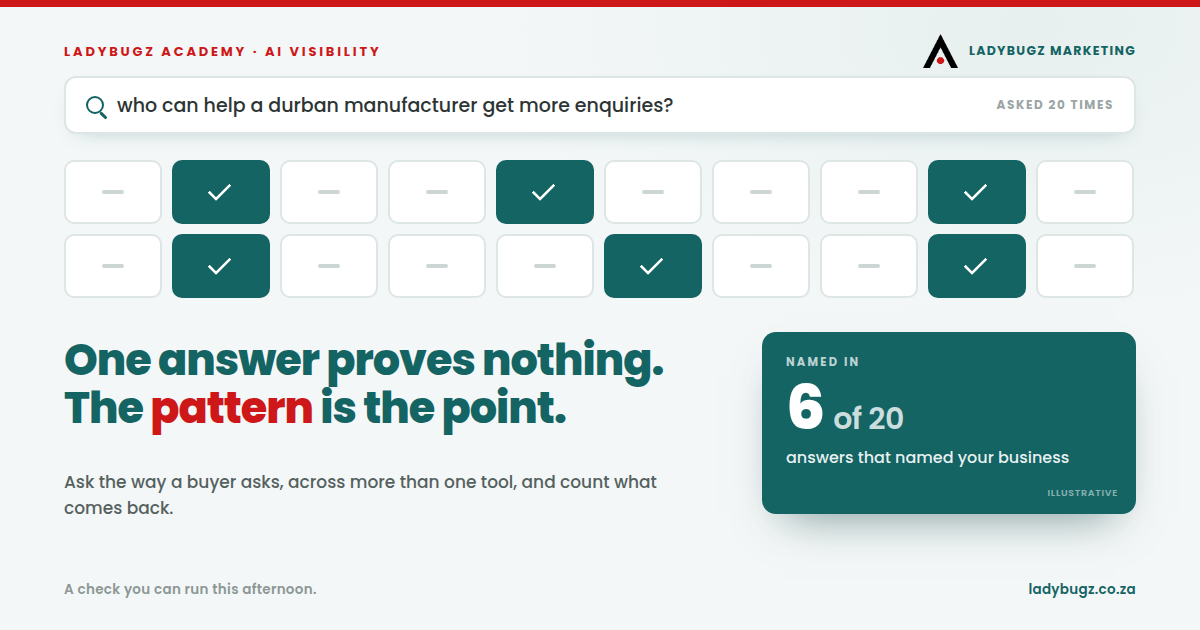
- One answer proves nothing. AI tools reply differently to different people, on different days, with slightly different wording. A single good answer and a single bad answer are both noise.
- Ask the way a stranger asks. For the second check, build your questions around your field, the skill and the place. Your own name stays out of them.
- Record three things every time. Whether you were named, who was named instead of you, and whether what the AI said about you was correct.
- Being left out usually has a cause. Either nothing you have published answers the question, or your profile uses words nobody would type, or the outside sources mentioning you are stale.
- This is already happening. In late September and early October 2026, four people contacted LadyBugz after an AI tool pointed them to us. One of them had asked ChatGPT who would be good to contact about LinkedIn.
Why is "does AI recommend me" a different question from "do I rank on Google"?
Search rankings and AI answers measure two different things, and the gap between them is wider than most people expect. A search engine hands someone a page of links. Ten results, a few ads, and a human being who decides what to click. A LinkedIn profile at number four can still get plenty of visits.
An AI tool does something else entirely. The person types a question in ordinary language, the way they would ask a colleague, and gets back a short written answer that names maybe two or three people with a line about each. Nobody else exists in that answer. No page two. No scrolling.
Gartner predicted in February 2024 that traditional search engine volume would drop 25% by 2026 as people move across to AI chatbots and virtual agents. Whether it lands exactly there matters less than the direction of travel.
I stopped treating this as a forecast at the end of September. Between late September and early October 2026, four separate people contacted me after an AI tool sent them to LadyBugz. I am not going to name them. One told me straight out that he had asked ChatGPT who would be good to contact about LinkedIn, and my name came back. Four enquiries is not a trend you can take to the bank. It was enough to make me ask the uncomfortable follow-up: how many of those conversations happen every week without my name in them?
Why one answer from an AI tool proves nothing
AI tools do not answer the same question the same way twice, and that single fact changes how you have to test them. Two people on different accounts, in different cities, with different chat histories behind them, can type identical words and get different names back. Run it again next week and the answer shifts again. Wording moves it too. "Best LinkedIn trainer in South Africa" and "who can help me get noticed on LinkedIn in Johannesburg" pull from different places.
So the job is to collect enough answers that a pattern shows through the noise. Someone who turns up in six replies out of twenty has a real presence. Someone who turns up once has had a good day.
Think of it like asking around at a conference. One person's recommendation tells you about that person, nothing more. Twenty of them tell you about your reputation.
What should you ask, and where?
The questions you choose decide whether this whole exercise is worth anything. Most people stop after the first check: they type their own name into ChatGPT, read a flattering paragraph, and feel reassured. That is a useful start, because it shows whether the AI can find you at all. It says nothing about whether you get named to someone who has never heard of you.
Here is the rough version, doable this afternoon.
- Ask for your LinkedIn profile by name. Type your full name, your field and your city, and ask the AI to find your LinkedIn profile and tell you what you do. Check that it found the right person and the right profile.
- Ask who the people to know are. Write five to eight questions a stranger might type: who are the people to know in your field in your area, who should I talk to about the thing you are good at, who would you hire for it. Your name appears nowhere. For example: "who are the people to know in brand photography in Durban".
- Use more than one tool. Two or three is plenty. Different tools read different parts of the web, so one tool is one opinion.
- Repeat on different days. Same questions, same wording, a few days apart. Ask a friend or colleague to run the same list from their own account.
- Record three things each time. Were you named. Who was named instead of you. What the AI said about you, word for word, if it said anything.
A spreadsheet does it: question, tool, date, who was named, what it said about you. Twenty rows and a pattern starts showing.
What should you look for in the answers?
Four things in those replies are worth your attention, and only one of them is about you.
Presence. Do you appear at all, and when you do, are you first or an afterthought at the end of a list? Count it rather than feeling it. People are terrible at estimating this.
The names that keep coming back. Watch who shows up across different questions and different tools. Those people are already in the conversation you want to be part of. Some of them will surprise you, and a few will have far less experience than you.
Accuracy. Read what the AI says about you with a cold eye. The wrong employer, a job you left two years ago, a skill you never claimed, someone else with your name mixed in. TrustRadius published its 2026 B2B Buying Disconnect Report in July 2026, drawn from 1,862 people buying technology and 444 vendors. It found 63% of them used AI during the purchase journey, and 94% of those AI users fact-check what it tells them at least some of the time. People do go and look. A stale description gets caught.
Where it got the information. Most tools will show you sources if you ask. Look at what they lean on. Your LinkedIn profile, an old speaker bio, a news piece, a podcast page, a personal site if you have one. That list tells you which parts of the web are speaking on your behalf, and how old their version of you is.
Why would AI leave you out?
Three causes cover most of it, and none of them is about the quality of your work. (If the terms are new to you, start with what AEO is and why people now look you up with AI.)
AI tools build an answer out of material that has been written down and published somewhere readable, then repeated often enough to look settled. If your expertise lives in your head and in the conversations you have at work, there is nothing there for a model to pick up.
- Nothing you have published answers the question. You know the answer. You give it to colleagues and clients every week. It has never been written down on your profile or in a post, which means that on this question, you do not exist.
- Your own words are the wrong words. Plenty of LinkedIn profiles describe a person in job-title language, the phrasing from an internal org chart. The person searching types what they need. When those two vocabularies do not meet, the match never gets made.
- The sources that mention you are thin, old or wrong. A speaker bio from 2019, a profile headline from two roles ago, a mention that spells your name differently. AI repeats what it finds, with confidence.
What you do about each one depends on where you are starting from and how much ground you have to make up, which is a longer conversation than one article. The principle holds everywhere though.
You cannot be named for something you have never said out loud in public, in the words people actually use.
The limits of checking this by hand
A hand check is a sample, not a census, and you should hold it loosely. You will run eight questions. Other people will type hundreds of variations you never imagined, half-formed, badly spelled, in words you would never choose. You catch a slice of that.
There is also the problem of keeping it going. You will do this once, find it interesting, promise yourself you will redo it monthly, and then a quarter goes by. Everybody does. Tracking it properly over time, across many questions and several tools, is a different job from checking it once on a Thursday afternoon. That gap is the reason we built the Academy the way we did.
And watch yourself for the comfortable habit of only re-running the questions where you came out well.
If you do one thing after reading this, do this. Ask two AI tools to find your LinkedIn profile, then ask each of them who the people to know are in your field and your area, and write down who gets named. Twenty minutes. Whatever comes back, you will know more about how you show up than you do right now, and you will have a short list of the people already in the conversation you want to be part of. That list alone is worth the twenty minutes.
Prefer to talk it through first? Email hello@ladybugz.academy.