
Why is AI slop hurting your LinkedIn profile, and what works instead?
A plain look at why your own LinkedIn profile matters more than ever, why posts written by AI are falling flat, and how coaching helps you write content that sounds like you and gets you found.
Your personal LinkedIn profile is often the first place a client or a hiring manager checks before they decide whether to talk to you. Posts produced by AI writing tools make that profile look like everyone else's, and readers notice. I see it every week in the LinkedIn profiles we assess at LadyBugz. The better route is to learn to position yourself and write in your own voice. An AI coach can help by scoring your work and asking you questions. It never writes it for you.
Key Insights
- Most of the deciding happens before anyone calls. 6sense's 2025 Buyer Experience Report, a survey of nearly 4,000 B2B (business to business) buyers, found they were about 61% of the way through their buying process before they first contacted a seller.
- People reach further than company pages. Richard van der Blom's Algorithm Insights Report 2025, built on 1.8 million LinkedIn posts, found company page posts reach (are actually seen by) only about 1.6% of their followers. The person behind the business is the one people see.
- Readers trust suspected AI content less. In a July 2025 Raptive study of 3,000 US adults, content that readers believed was written by AI cut their trust by nearly half.
- Decision makers prefer a human voice. The 2025 Edelman and LinkedIn B2B Thought Leadership Impact Report found 65% of "hidden buyers" (the people behind the scenes who influence a purchase), surveyed among US decision makers, prefer a human, less formal tone.
- Slop now has a dictionary entry. Merriam-Webster chose "slop" as its 2025 Word of the Year and defined it as digital content of low quality that is produced usually in quantity by means of AI.
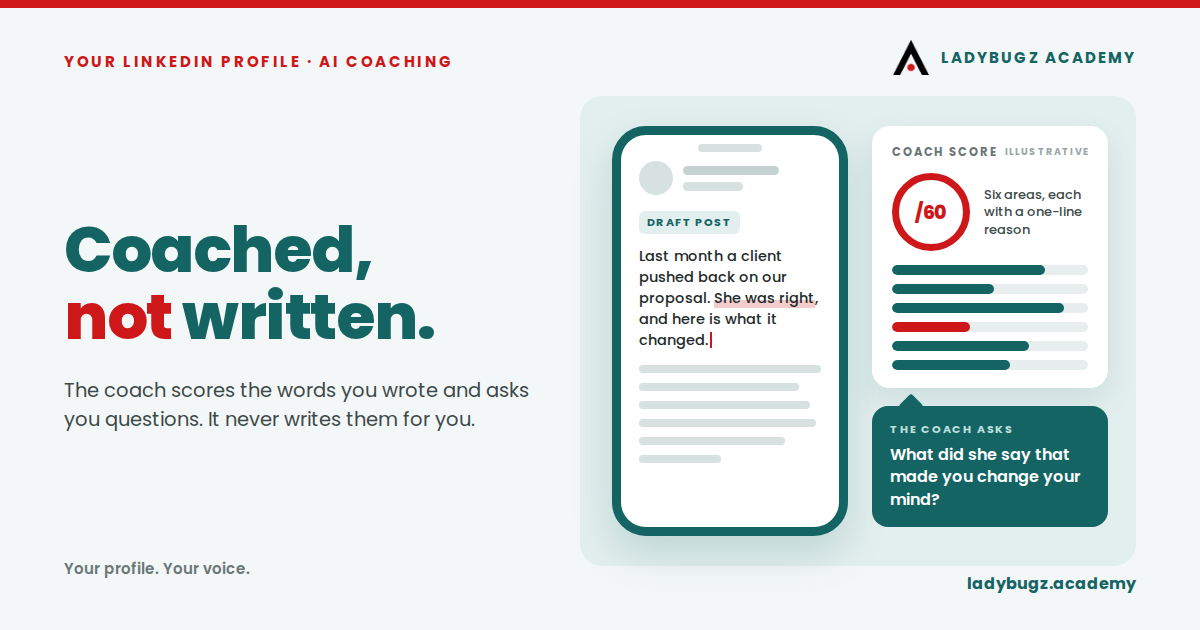
- How LadyBugz Academy coaches. Every coaching round scores your own text out of 60 across six areas, gives a one-line reason for each score and asks you two or three questions. The coach never writes the text for you.
What do personal brand, positioning and AI slop actually mean?
A personal brand is what people find and say about you when you're not in the room. Positioning is what you choose to be known for, and AI slop is the bland, mass-produced AI content clogging up LinkedIn.
Start with the personal brand. On LinkedIn that is your profile, your posts and the comments you leave on other people's posts. Everyone has one. You either shape it or leave it to chance.
Positioning is the decision about what you want to be known for, and by whom. A photographer who "does everything" is hard to recommend. A photographer known for relaxed, natural team portraits for law firms is easy to recommend, because people can picture exactly when to send someone their way.
AI slop is the one getting in the way. Merriam-Webster's 2025 Word of the Year announcement defined slop as "digital content of low quality that is produced usually in quantity by means of artificial intelligence." On LinkedIn you will recognise it within two lines:
- an opening question nobody asked
- a tidy list of "lessons" that could belong to any industry
- words that sound impressive and mean very little
- a closing "What do you think?" that gets no replies
You've scrolled past dozens of these this week. So have the people you want to work with.
Why does your own LinkedIn profile matter more than a company page?
Your own profile matters because the people who might hire you or work with you do their homework before they get in touch, and company page posts reach very few of their own followers. If you have a company page, it has its place. Your profile is where people meet you.
Look at reach first, meaning how many people actually see a post. Richard van der Blom's Algorithm Insights Report 2025 analysed 1.8 million posts and found that company page posts reach only about 1.6% of a page's followers. A page with 2,000 followers might put a post in front of around 30 of them. A founder or a senior consultant with a few thousand connections who often like and comment can often reach more people with one thoughtful post.
Then look at timing. 6sense's 2025 Buyer Experience Report found that B2B buyers were about 61% of the way through their buying journey before they first spoke to a seller, and in 79% of cases they said they made first contact, not the seller. If the people you want to work with behave anything like that, most of the judging happens before you know anyone is looking. Your headline and your last few posts are doing the talking while you're busy with something else.
To me, LinkedIn is first a place to win work, a business development platform. It's where your next piece of work is decided, often by someone you've never met.
When I first started out, I didn’t have brand credibility, but my LinkedIn profile explained what I did. It was my personal business card and ever changing, as the business changed. I landed a client for training, without speaking to him. His secretary called and emailed and requested a proposal, it was signed off AND paid for, before I even shook his hand for the first time.
For you, that has a practical meaning. If your profile is thin or out of date, or it's full of generic posts, that's the impression people take away. If it says clearly what you do and who you help, you look like someone worth calling. A good first step: update your headline this week, then post once a week, in your own words.
Why isn't AI-written copy working on LinkedIn?
AI-written copy isn't working on LinkedIn because it sounds like everybody else, and readers trust it less when they suspect it. Both cost you the trust a personal profile is meant to build.
The trust numbers made me sit up. Raptive's July 2025 study of 3,000 US adults tested how people react to articles written by people and by AI. When readers suspected the content came from AI, their trust in it fell by nearly 50%. The 2025 Edelman and LinkedIn B2B Thought Leadership Impact Report found that 65% of hidden buyers (the people behind the scenes who influence a purchase) prefer a human, less formal tone over a polished, intellectual one. So if the people you want to reach include decision makers, sounding like a person counts.
And there's plenty of it about. Pangram Labs, a company that builds AI detection tools, checked just over a million social media posts from late April 2026, and more than 40% of the long LinkedIn posts (over 250 words) came back as fully AI-generated. That was their own detection tool's call, on posts from people who use their checker, so read it as a sign of how crowded the feed has become rather than an exact count.
LinkedIn has noticed too. Its Chief Product Officer, Hari Srinivasan, said in a LinkedIn post in July 2026 that AI slop is "a top priority", and members are getting a way to flag posts that seem like it. I haven't found a solid 2026 number for how much reach an AI-written post loses, so I'm not going to give you one. If four in ten long posts in your feed were written by a machine, the post that sounds like you is the one people stop for.
There is a simpler reason, too. AI writing tools are built to produce the most likely next sentence. The most likely sentence tends to be the one anyone else would write. Your expertise lives in the unlikely parts:
- the client who pushed back and what you learnt from it
- the number from last month's project
- the opinion your peers disagree with
- the mistake you made early in your career
No tool knows those things unless you tell it. And once you know them well enough to tell it, you can usually write the post yourself.
I use AI every day, and I built an AI coaching platform. The question is what you let the AI do. I let it check my thinking. I don't let it put words in my mouth, not with the people deciding whether to hire me.
How do you position yourself so the right people find you?
You position yourself by deciding who you want to be found by and why they'd look for someone like you. Then work out what you bring that others don't. Once that's clear, your profile and your posts have something to stand on.
Most people skip this step and go straight to posting. Then they wonder why their posts get polite likes from friends and nothing from the people they want to work with. Here is where I would start:
- Pick a lane. Choose one or two topics you could talk about for seven minutes without notes. That is your lane for the next few months.
- Write your headline (the line under your name) for the person searching. Say what you do and who it is for, in the words a client would type. A job title alone tells them very little.
- Put proof in your About section (the summary near the top of your profile). A number, a result, the kind of client you serve, a project people will recognise. Something a reader can check or picture.
- Use your Featured section (the showcase strip under your About section). Pin the post, article or piece of work you most want a stranger to see first.
- Keep your current role current. If the Experience entry for your current job still describes the job you had two years ago, people notice.
When I first started out, I wanted to be an agency for everyone! I soon realised how I stand out from everyone else in marketing. This was my years of B2B sales and marketing experience using LinkedIn, organically. This is where I changed how I positioned my business.
What type of content should you focus on?
Focus on content anchored in something real that only you could have written. Make it easy to read on a phone and end it in a way that invites a proper reply. Fewer posts of that kind will do more for you than a daily stream of generic ones.
In practice, the posts that build a name tend to share a few habits:
- They start with something concrete. A moment, a number, a client question, a photo from the job.
- They hold one idea. One clear point lands. Try to make five points in one post and readers remember none of them.
- They are easy to skim. Short paragraphs and white space, because many people read LinkedIn on a phone between meetings.
- They end with something worth answering. A real question about the reader's own experience, not a generic "Thoughts?"
Comments count as content too. A thoughtful comment on someone else's post in your field puts your name in front of their audience, and it is often the fastest way to be noticed by people who don't know you yet. A comment that just says "Great post!" does nothing for you.
You never know what a person is going through on the other end of a DM or comment. Something I try to keep up with is saying “Happy Birthday” to my connections with a personal message. Something encouraging. Show up authentically… and who knows, you may even land your next client… I did!
How an AI coach scores your content without writing it for you
The LadyBugz Academy coaches score the text you wrote out of 60 across six areas, with a one-line reason for each score and two or three questions to make you think. They don't rewrite your words. If the AI ever tries to slip in its own wording, the reply is rejected and you're not charged for that round.
There are six coaches in the Academy. They're listed here in the order the Academy shows them:
- Personal Brand Copywriter. Despite the name, it doesn't write for you. It coaches your LinkedIn posts and articles so they sound like you, not like AI. You can add notes on how you like to write, and the coach checks your draft against your own voice.
- Content Performance Coach. Scores a LinkedIn post before or after you publish it, area by area, with a reason for each score.
- LinkedIn Profile Optimiser. Coaches your headline, About section and current role. The coach reads text only, so the parts it cannot see, such as your photo and banner, are scored from a short checklist you tick yourself.
- Story-Selling Profile Builder. Helps you shape your mission one-liner, the single line that says what you do: your topic, your point of view, who you help, the result you bring, your proof and whether it sounds like you.
- Comment Catalyst. Coaches the comments you leave on other people's posts, so they start real conversations.
- Audience Compass. Coaches your answers to three questions about who you want to be found by, so every other coach has something sharp to build on.
I chose scores and questions over rewrites on purpose. A rewrite teaches you nothing. You paste it in and next week you're stuck again. A score with a reason shows you the gap, and a good question makes you fill it yourself, in your own words. By your tenth post you'll lean on the coach less, which is what I want for you.
The score also gives you something most people never have, a way to see your own progress. Compare this month's score with last month's. That's the only race that counts.
Alongside the coaches, the Academy's AI visibility scan gives you your My AI Score, out of 100. It checks whether AI tools find your LinkedIn profile, describe you in your field and name you when someone asks who the people to know are in what you do. To see why that matters, read how to check whether AI recommends you and our plain guide to what AEO is (answer engine optimisation, which means getting found and recommended by AI tools).
Frequently asked questions
Can I still use AI for my LinkedIn content?
Yes, as a thinking partner. Use it to research a topic or to coach you. Be careful about letting it write the words people will read as yours, because readers trust suspected AI content less.
Does LinkedIn penalise AI-written posts?
As far as we know, LinkedIn hasn't published a rule against AI-written posts that we can point to. It has said AI slop is a top priority, members are getting a way to flag it, and Raptive's 2025 study shows readers trust suspected AI content less. Write the words yourself and use AI to research or check your thinking.
Does the Academy coach ever write my post for me?
No. It scores what you wrote, explains each score and asks you questions. Any reply that tries to rewrite your text is thrown out, and you're not charged for that round.
Do I need a website or a company page to use the Academy?
No. The Academy is built around you and your personal LinkedIn profile. A website or company page helps if you have one, and it's never held against you if you don't.
Where to start this week
Start by reading your own profile as a stranger would, then write one post in your own words. If I were sitting across the lunch table from you, I'd put it like this: open your profile and read it cold. Does your headline say who you help? Does your last post sound like you? If the answer is no, don't hand the problem to a tool that will make you sound like everyone else. Pick your lane, then let a coach show you where your post is strong and where it's thin. Next week, do it again.
Want to know why we built the Academy? Read why we built this, or email us at hello@ladybugz.academy.